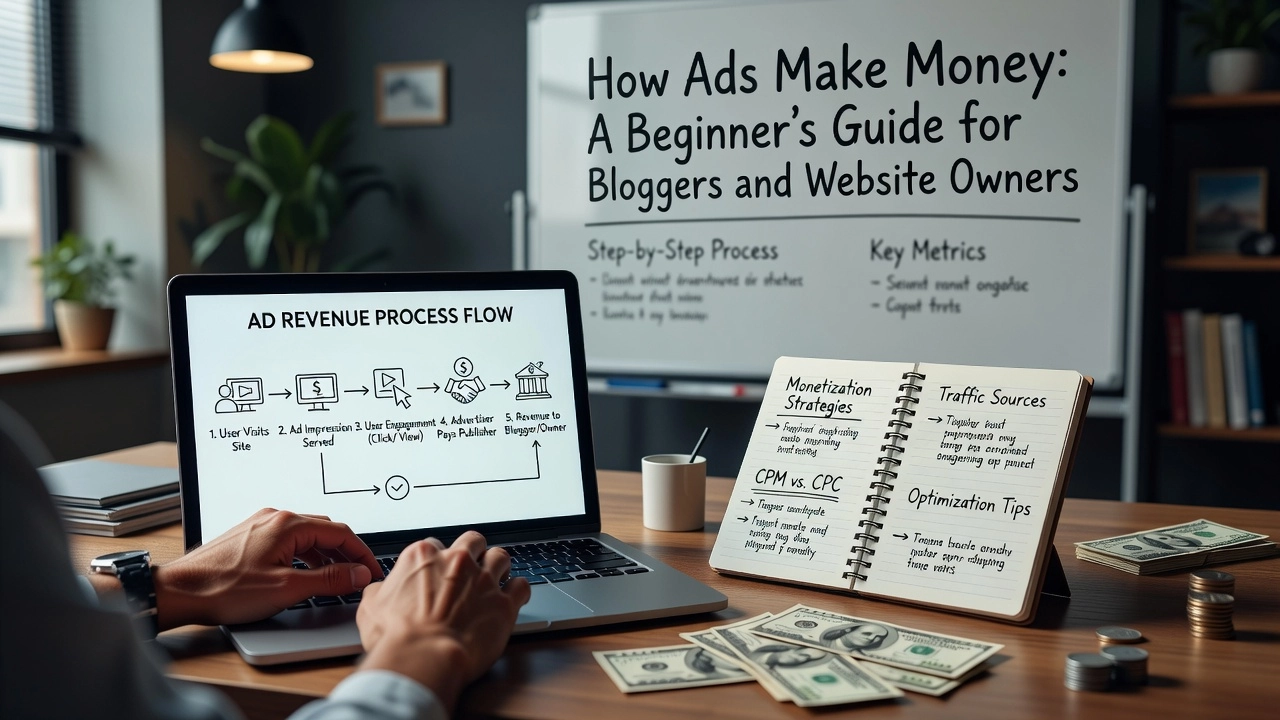
How Ads Make Money: A Beginner’s Guide for Bloggers and Website Owners
You’ve probably seen ads plastered all over websites and wondered, “Wait, how does this actually make anyone money?” Maybe you just started a blog and someone told you to “monetize with ads,” but nobody explained what that really means. Sound familiar?
Here’s the good news: understanding how ads make money is not nearly as complicated as it sounds. Once you break it down, the whole process starts to make a lot of sense, even if you have zero experience in digital marketing or tech.
In this beginner-friendly guide, we’re going to walk through everything you need to know about ad monetization. You’ll learn the different ways ads generate income, what terms like CPM, CPC, and RPM actually mean, and how platforms like Google AdSense fit into the picture. By the end, you’ll have a clear understanding of how website owners earn real money simply by displaying ads on their pages.
Whether you’re brand new to blogging or just curious about turning your site into a source of income, you’re in the right place. Let’s get started.
How the Ad Ecosystem Works
If you want to understand how ads make money, it helps to start with the big picture. The online advertising world runs on a three-party relationship, and once you see how it fits together, everything else clicks into place.
The three players are advertisers, publishers, and ad networks. Advertisers are businesses that want their products or services seen by the right people. Publishers are website owners like you, people who have built an audience and have digital space to offer. Ad networks sit in the middle, acting as the matchmaker between the two sides. According to how Google makes money with ads, publishers can choose to have networks like Google provide and serve ads on their behalf, with the majority of revenue going to the publisher and the network keeping a smaller share for facilitating everything.
Recommended Reading


Think of your website as a billboard on a busy road. Just as a physical billboard earns money based on how many drivers pass by and who those drivers are, your website earns money based on your traffic and your audience. A billboard next to a car dealership is worth more to a car brand than one on a quiet country lane. The same logic applies online.
Here is the part most beginners find reassuring: you do not need to hunt down advertisers yourself. The ad network handles matching, billing, and payment entirely on your behalf. You simply add a piece of code to your site, and the network automatically auctions your available ad slots to relevant advertisers in real time.
Those ad slots make up what is called your ad inventory, and their value is not fixed. It shifts based on who is reading your content and what they care about. A visitor browsing a personal finance article is more commercially valuable than a casual reader, because finance advertisers are willing to pay more to reach that audience.
To appreciate just how dominant this model has become, consider this: over 80% of Google’s total revenue comes from advertising. That single statistic tells you everything about why advertisers are willing to spend heavily and why publishers of all sizes can reliably tap into this ecosystem to generate real income from their content.
The Three Core Ad Revenue Models Explained
Now that you understand who the players are, let’s talk about the part most beginners are really curious about: how does the money actually get calculated? There are three core models that power almost every ad arrangement you’ll encounter as a publisher, and each one pays you in a slightly different way.
CPM: Getting Paid for Eyeballs
CPM stands for Cost Per Mille, where “mille” is Latin for one thousand. Under this model, you earn a fixed rate for every 1,000 times an ad is displayed on your pages, regardless of whether anyone clicks it. Think of it like renting out a billboard; the advertiser pays for the exposure, not the foot traffic walking through the door afterward.
Here’s a plain-English example: if your site gets 10,000 page views and your CPM rate is $5, you earn $50. The calculation is simply (10,000 divided by 1,000) multiplied by $5. Nobody needs to click anything. CPM works best for sites with high traffic volumes, because your earnings scale directly with how many pages get viewed. Your niche matters a lot here too; a finance-focused audience typically commands much higher CPM rates than a general lifestyle blog, because advertisers compete more aggressively for financially motivated readers.
CPC: Getting Paid for Clicks
CPC stands for Cost Per Click, and this model only pays out when a visitor actually clicks on an ad. No click, no earnings, even if thousands of people saw the ad. Rates vary enormously depending on your content niche. Finance, legal, and insurance topics tend to attract higher per-click values because advertisers in those industries can afford to pay more for a motivated lead.
A simple example: your page shows 500 ads, three people click, and each click pays $0.40. You earn $1.20 total. The other 497 impressions pay you nothing under a pure CPC arrangement.
CPA: Getting Paid for Actions
CPA (Cost Per Action, sometimes called Pay Per Action) is the highest-friction model of the three. You only earn when a visitor completes a specific action after clicking an ad, such as signing up for a newsletter, filling out a form, or making a purchase. Because the advertiser only pays on a confirmed result, individual payouts are typically far higher than CPM or CPC rates.
Example: an advertiser pays $20 per newsletter sign-up. Your content sends 200 visitors to their page and five sign up. You earn $100, but receive nothing for the other 195 who left without acting. The rewards are bigger, but so is the bar you need to clear. You can read more about how publishers can structure these models to increase revenue depending on their audience and niche.
How Beginner Platforms Blend These Models
Here is something that surprises a lot of new publishers: most beginner-friendly ad platforms, including Google AdSense, do not lock you into a single model. Instead, they run a real-time auction behind the scenes every time a page loads. Some advertisers in that auction are bidding on a CPC basis, others on a CPM basis, and the highest bid wins that particular ad slot. This means one page load might earn you a CPC payment, while the very next earns a CPM payment, depending on which advertiser won the auction.
This blended approach, rooted in programmatic advertising mechanics, actually works in your favour as a beginner because it maximises competition for your inventory without you having to manage anything manually. Understanding how ad revenue works at a mechanical level helps you make smarter decisions about your content strategy, ad placement, and which niches to focus on as you grow.
What Programmatic Advertising Actually Means
Think of programmatic advertising as a lightning-fast auction happening in the background every single time someone visits your website. The moment a page starts loading, your available ad space is put up for bidding, advertisers compete against each other in real time, and the winner’s ad appears on screen. The whole process takes roughly 100 to 200 milliseconds, which is faster than a blink. You never see it happening, but it is constantly working to get you the best possible price for your ad space.
The biggest win for publishers here is automation. Before programmatic existed, selling ad space meant negotiating deals manually, often settling for fixed bulk prices that left money on the table. Now, because multiple advertisers are competing for every single impression on your site, the price is driven upward naturally. You set things up once, and the system handles the rest. No phone calls, no contracts, no chasing advertisers. More competition among buyers almost always means better earnings for you.
There is a more advanced technique worth knowing about called header bidding. Rather than asking ad networks one at a time whether they want to buy your space (which meant early responders could win cheaply by default), header bidding lets multiple buyers compete at exactly the same time. Publishers who have adopted it typically report significant increases in ad revenue, simply because the auction becomes genuinely competitive rather than just sequential. You do not need to set this up right away, but it is useful to understand why it exists.
Platforms like Google Ad Manager are used by thousands of publishers worldwide to run programmatic advertising, valued for their performance, controls, and ability to connect with a wide range of third-party ad tools. You can learn more about how ad revenue works for publishers as your setup becomes more sophisticated.
If all of this sounds technical, do not worry. Google AdSense handles the entire programmatic process automatically for new publishers. You add the code to your site, and AdSense runs the auctions on your behalf. It is genuinely the easiest entry point available, and it is how most successful publishers get started before exploring more advanced options later on.
What Actually Affects How Much You Earn From Ads
So you’ve got ads running on your site. Great! But here’s the thing that surprises most beginners: two websites can have the exact same amount of traffic and earn wildly different amounts. One might pull in $500 a month while the other earns $5,000. The difference comes down to a handful of factors that are well worth understanding.
Where your visitors come from matters enormously. Advertisers in the UK, US, Australia, and Canada consistently bid more aggressively for ad placements than advertisers in other markets. This is simple supply and demand. Those are high-income, English-speaking economies where a single new customer is worth significantly more to a business. So if most of your readers are based in those countries, you’ll earn higher CPMs and CPCs almost automatically. Publishers with the same traffic volume but a primarily US or UK audience can outperform others by a substantial margin, purely on geography alone.
Your content niche sets your earning ceiling. This one surprises a lot of newer bloggers. Write about finance, legal topics, insurance, or software, and advertisers will compete hard to appear on your pages. Why? Because in those industries, a single converted customer can be worth thousands over their lifetime. An insurance company can comfortably bid $20 or more per click because landing one new policyholder covers that cost many times over. Compare that to a lifestyle or entertainment blog, where “healthy breakfast ideas” might attract advertisers paying well under $1 per click. Your topic is not just a creative choice; it’s a financial one. As research into high-CPC AdSense niches confirms, two sites each getting 100,000 monthly visitors can earn $500 versus $5,000 depending on niche and audience quality alone.
Traffic quality beats traffic quantity every time. A reader who finds your article through organic search, reads it carefully, and spends several minutes on your site is far more valuable than ten visitors who bounce within seconds from a low-quality source. Advertisers know this, and their bidding reflects it. Organic search traffic consistently commands higher advertiser bids because it signals genuine interest and purchase intent. Chasing shortcuts to inflate your visitor numbers almost always backfires on ad earnings.
Session depth quietly multiplies your revenue. Every additional page a visitor browses generates another ad impression. Someone who reads three articles in a single visit creates roughly three times the ad inventory of someone who reads one and leaves. This makes internal linking and genuinely compelling content structure directly relevant to your monthly earnings, not just your content strategy.
Ad viewability is something many beginners overlook entirely. An ad that loads below the fold and never gets scrolled into view earns very little, sometimes nothing at all. Most programmatic buyers won’t pay full rates for impressions that weren’t actually seen. Placing ads thoughtfully within your content, above the fold where possible, and keeping your pages loading quickly all feed directly into whether your impressions count as viewable.
Finally, and this connects everything together: SEO is one of the most underused levers for improving ad income. Targeting high-CPC keywords through your content strategy means better-quality organic traffic, which attracts higher-paying advertisers, which improves your earnings per visitor. As insights into fixing low AdSense CPC confirm, improving CPC through smarter topic and keyword selection is often more effective than simply chasing more traffic. Better SEO, better traffic, better ad revenue; it really does work as a chain.
Google AdSense: The Natural Starting Point for Bloggers
If you’ve been following along, you now know how the ad ecosystem works and what affects your earnings. So where should a brand new blogger actually start? For most people, the answer is Google AdSense, and there are some very good reasons for that.
AdSense is Google’s free programme that lets you display ads on your website and earn money from your content. What makes it so beginner-friendly is that Google acts as the middleman between you and thousands of advertisers. You never have to pitch to brands, negotiate rates, or chase payments. Google handles all of that on your behalf, connecting your site to what it describes as the largest network of online advertisers in the world. There is also no minimum traffic requirement to apply, which means you can get started even if your blog is relatively new.
Getting Your Site Approved
The application process is straightforward once you know what to expect. You start by creating or connecting a Google account, then add your website to AdSense and paste a small code snippet into your site’s header. From there, Google reviews your site, which typically takes anywhere from a few days to a couple of weeks depending on how well set up your site is.
One thing worth knowing is that Google’s approval standards have tightened up recently. With so much AI-generated content flooding the internet, Google is being more careful about which sites it approves. Before you apply, it helps to have a clear About page, a Contact page, and a Privacy Policy in place. Having a solid collection of genuine, helpful posts in a focused niche will also put you in a much stronger position.
How AdSense Fills Your Ad Spaces
Once approved, you do not need to go out and find advertisers yourself. Google uses a combination of contextual targeting (matching ads to what your page is actually about) and behavioural targeting (showing ads based on what your visitor has previously browsed) to fill your ad slots automatically. You simply choose where you want ads to appear on your site, and Google takes care of the rest.
Getting Paid
AdSense pays on a monthly cycle via bank transfer. Your earnings from one month are finalised by the 3rd of the following month, and payment is typically issued between the 21st and 26th of that month, as long as your balance has hit the payment threshold. In the UK, that threshold currently sits at £60. You can check exactly how your earnings are building up at any time through the AdSense payment dashboard, which breaks everything down clearly.
If your earnings do not reach £60 in a given month, your balance simply rolls over until it does. It is a reassuring system for beginners who are still building traffic.
CPC, CPM, and What You Actually Earn
AdSense uses a mix of CPC (cost per click) and CPM (cost per thousand impressions) depending on what advertisers are bidding for at any given moment. This means your earnings per page view will vary, sometimes quite a bit. Typical earnings range from around $0.20 to $2.50 per thousand page views, with your niche, your audience’s location, and the quality of your content all playing a role. Publishers in finance or software niches, for example, tend to earn more per click than those in entertainment because advertisers in those industries bid higher. The key metric to keep an eye on is your RPM (revenue per mille), which gives you a normalised view of your earnings regardless of whether income came from clicks or impressions.
The good news is that your results improve over time as you test different ad placements and focus on creating content your audience genuinely engages with. Better content leads to longer session times, which leads to more ad impressions and better signals for Google’s targeting.
If you are ready to take the next step, brianhillier.co.uk offers practical AdSense guidance and resources specifically aimed at bloggers and website owners. It is a great companion resource to have alongside you as you work through your setup and start optimising your earnings.
Realistic Earnings for New Bloggers: What to Actually Expect
Let’s be honest with you here, because the internet is full of “I made $10,000 in my first month blogging!” stories that do more harm than good. The reality for most new bloggers is a lot quieter in the early months, and that’s completely normal.
The First Six Months: Patience Is Part of the Process
During months one through three, your main job is building content and getting your SEO foundations in place. Google takes time to crawl, index, and rank new content. Even if you publish excellent articles consistently, the search engine is essentially still getting to know your site. Traffic at this stage is typically minimal, which means ad earnings are too. We’re talking anywhere from a few cents to maybe a few dollars per day. That’s not failure; that’s simply how the timeline works.
Months four through six are when things start to shift. Google begins surfacing your indexed content in search results, and traffic starts showing up in your analytics in a more meaningful way. You might start earning $10 to $100 per month from ads during this window, depending on how consistently you’ve been publishing and how well your content is targeting the right keywords. It’s not life-changing yet, but it’s real, and it’s growing.
What the Numbers Look Like as You Scale
From month six onward, consistently publishing sites begin to see compounding returns. A small publisher reaching around 20,000 monthly visitors can realistically earn between $500 and $3,000 per month from display ads in 2026. Mid-size publishers with hundreds of thousands of monthly visitors can earn anywhere from $10,000 to $50,000 per month. The gap between those two tiers is wide, and it comes down to several compounding factors rather than traffic alone.
Two sites with identical visitor counts can earn dramatically different amounts based on their niche, the geographic location of their audience, ad placement quality, and how long visitors stick around per session. A personal finance blog targeting US readers might command an RPM of $15 to $25, while a general lifestyle blog might sit closer to $3 to $6. According to blogging statistics compiled for 2026, content quality and audience engagement are becoming more critical than ever as competition for organic traffic increases.
The Formula That Keeps You Moving Forward
The publisher revenue formula is straightforward: Traffic, then Engagement, then Monetisation, then Optimisation, then Scale. You don’t skip steps, and you don’t rush them. Only 14% of bloggers earn any income from their blogs, but that statistic is misleading without context. A large proportion of that 86% simply stopped publishing before the compounding effects had any chance to kick in. The bloggers who do earn meaningful ad revenue are almost always the ones who kept going past the quiet early months.
Think of your blog like a garden. You plant seeds in months one through three, and you water them consistently. The sprouts appear in months four through six. By month six and beyond, you’re starting to see real growth, and that’s when optimising your ad placements and improving your RPM actually makes a measurable difference to your bottom line.
How to Place Ads on Your WordPress Site
Once your ads are approved and ready to go, the next step is actually getting them onto your WordPress site. There are three main ways to do this, and the right choice depends on how comfortable you are with the technical side of things.
The first and most beginner-friendly option is using a dedicated ad management plugin. Plugins like Advanced Ads give you a visual interface to control exactly where your ads appear, without touching a single line of code. You can set rules like “show this ad after the third paragraph of every blog post” or “only display this unit to first-time visitors.” It’s a genuinely powerful setup that removes a lot of the guesswork, and it’s the approach most beginners will feel most comfortable with from day one.
The second option is widget-based placement. WordPress comes with a built-in widget editor, and you can drop a Custom HTML widget into your sidebar, header, or footer area and paste your ad code straight inside it. This is a quick win if you want a banner ad to appear across every page of your site without installing anything extra. The trade-off is flexibility; widgets can’t easily target specific posts or categories, so if you want more control over where and when ads show, a plugin is still the better long-term choice.
The third method is editing your theme templates directly, which means inserting ad code into PHP files like header.php or single.php. This gives you maximum control, but it’s also the riskiest option for beginners. One small mistake can break your layout, and your changes will be wiped out whenever you update your theme. It’s worth knowing this option exists, but most people won’t need it.
If you’re using Google AdSense, there’s also a fourth shortcut worth knowing about: Auto Ads. Once you add a single AdSense script to your site header, Google uses machine learning to automatically find the best placement spots across your pages. It’s a great hands-off starting point before you begin fine-tuning positions manually.
One practical thing to keep an eye on once your ads are live is page speed. Ad scripts add extra load to your site, and if things start slowing down, it affects both your visitor experience and your SEO rankings. Run a speed test before and after adding your ad code, enable lazy loading for ads where your plugin supports it, and avoid stacking too many ad scripts from different networks at once. A fast-loading site with a few well-placed ads will always outperform a slow one covered in banners.
Why Ad Blockers Affect Your Earnings and What You Can Do
Here is something that might catch you off guard: a visitor can land on your page, read your entire article, and leave without earning you a single penny in ad revenue, even if your ads are set up perfectly. That is what ad blockers do. They are browser extensions or built-in browser features that intercept the scripts that load advertisements before those ads ever appear on screen. The page loads fine from the visitor’s perspective, but the ad never renders, no impression is recorded, and no revenue is generated from that visit.
It is worth knowing that this is not a niche problem affecting a tiny fraction of websites. Global ad blocker adoption has grown steadily year on year, and the audiences most likely to use them tend to be tech-savvy readers, developers, and gamers. If your blog covers topics like software, coding, or web design, a noticeably higher proportion of your visitors may be using ad blockers compared to a general lifestyle or food blog. Your niche genuinely shapes your exposure to this issue, so it is worth being aware of even if you cannot know the exact numbers for your own site.
The honest truth is that this is largely outside your control as a publisher. Attempting to block ad blocker users from accessing your content or hitting them with aggressive pop-up warnings tends to frustrate people and push them away entirely, which damages trust far more than losing a few ad impressions.
The smarter response is to build an income model that does not rely entirely on display ads. Affiliate links work completely outside the ad-serving system ad blockers target, so those clicks and commissions still come through. Sponsored content, digital products, and newsletter partnerships all function the same way. Ad blocker users can still contribute real value to your revenue through those channels.
Think of it this way: understanding ad blockers is actually useful motivation to diversify sooner rather than later, building something more resilient and sustainable from the start.
How to Attract Higher-Paying Advertisers to Your Site
Here is something worth understanding before you try to increase your ad earnings: advertisers are not just buying space on your website. They are buying access to your audience. Specifically, they are paying for the chance to get in front of people who are likely to take action, whether that means clicking a link, requesting a quote, or making a purchase. The more targeted and engaged your readers are, the more valuable that access becomes, and the more advertisers are willing to pay for it.
This is why your niche matters so much more than most beginners realise. Writing about personal finance, business software, insurance, or legal topics places you in categories where advertisers compete heavily for every click. The reason is simple economics. An insurance company can afford to pay $20 or even $30 per click because a single new customer might be worth thousands of pounds over their lifetime. Compare that to a lifestyle blog covering recipe ideas, where a typical CPC might sit well under £1. The gap is not small; it is enormous, and it directly shapes your earning potential.
Your SEO strategy is one of the most powerful tools you have for influencing this. When you rank for high-intent, commercially focused keywords, you attract visitors who are actively searching for products or services rather than casually browsing. That kind of audience is exactly who premium advertisers are bidding to reach through programmatic platforms. Identifying those high-value keyword opportunities does not have to be complicated. The free SEO tools and resources available at brianhillier.co.uk are a practical starting point for finding the kinds of keywords that bring in better-quality traffic and, in turn, stronger ad earnings.
Session quality also plays a bigger role than most people expect. Programmatic platforms track signals like time on site, bounce rate, and pages viewed per visit. When visitors stay longer and explore more of your content, it signals that your audience is genuinely engaged, and that makes your ad inventory more attractive to buyers.
Finally, content quality and brand safety are non-negotiable for premium advertisers. Clean, well-structured, original content is far more likely to attract higher-tier demand through programmatic channels. Thin pages or poorly formatted articles can actively limit your access to better-paying advertisers, no matter how strong your niche is.
Beyond Display Ads: Building a More Resilient Revenue Model
Here is something that catches a lot of bloggers off guard once they start earning from display ads: the publishers who make the most money are rarely relying on ads alone. The smartest approach in 2026 is what’s known as revenue stacking, which simply means layering multiple income streams on top of each other so that the same traffic works harder for you. Think display ads, affiliate marketing, sponsored content, digital products, and email monetisation all running together. Each one adds another layer to your monthly income, and the combined effect is far more stable than any single channel on its own.
The great news is that affiliate marketing and display ads are natural partners. An article that earns a few cents per thousand impressions from ad views can also include affiliate links pointing readers toward relevant products or services. The same visitor, reading the same page, can generate revenue from both sources at the same time. You are not choosing one over the other; you are simply giving your content more ways to earn. This is one of the core strategies covered in the affiliate marketing guides over at brianhillier.co.uk, and it is well worth exploring once your ad setup is in place.
It is also worth knowing that AdSense is not the only ad network available to you. PropellerAds is a strong alternative worth looking into, particularly if AdSense does not suit your niche or audience type. It supports a wider range of formats including push notifications, and its CPM dynamics can work differently depending on your traffic geography and content category. Brian covers PropellerAds in detail on the site, so that is a logical next step if you want to compare your options.
Finally, diversification genuinely protects you. CPM rates fluctuate with advertiser budgets and seasons. Algorithm updates can reduce your organic traffic overnight. Ad blockers quietly reduce your visible impressions. These are all things entirely outside your control, and having multiple income streams means one bad month for display ads does not derail everything you have built.
Start Small, Think Long Term
At its core, the whole system comes down to this: advertisers want to reach your audience, your website is the platform that makes it happen, and you get paid through impressions, clicks, or actions depending on the model in play. That is genuinely all it is. Everything else is just the detail on top of that foundation.
Your roadmap from here is straightforward. Start with AdSense, build SEO-driven content that attracts the right visitors, fine-tune your ad placement as you learn what works, and then layer in additional income streams as your traffic grows. Each step builds on the last, and none of it has to happen overnight.
Low early earnings are completely normal. The publishers making thousands per month started with the same quiet dashboards you are looking at right now. Growth compounds over time, not overnight.
So pick one action today. Apply for AdSense, install an ad plugin on WordPress, or head over to brianhillier.co.uk and use the free SEO tools to find better-paying keywords in your niche. One step forward is all it takes to begin.
Conclusion
Ad monetization does not have to feel like a mystery. By now, you understand the core ways ads generate income, what key metrics like CPM, CPC, and RPM actually mean, and how platforms like Google AdSense connect website owners with advertisers. Most importantly, you know that real people with real websites are earning consistent income simply by sharing content they love.
The best part? You do not need to be a tech expert or marketing guru to get started. You just need a website, quality content, and a willingness to learn as you grow.
So take that next step. Sign up for an ad network, experiment with ad placements, and start tracking your results. Every successful blogger started exactly where you are right now. The sooner you begin, the sooner those first earnings will start rolling in.